
Building Emotional Resilience in Children Through Everyday Moments

Updated: 2 days ago
By Michael R Kiel, MA, LPC
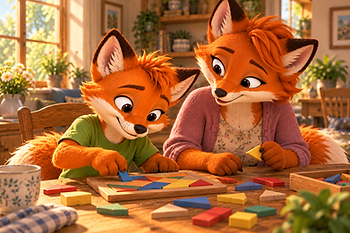
Your child loses a game they really wanted to win.
The afternoon plan suddenly changes.
They can't get something to work the way they imagined.
You tell them they have to wait.
They need help with something they were determined to do by themselves.
None of these moments necessarily look very important from the outside.
But childhood is filled with them.
And over time, these ordinary moments can give children opportunities to experience disappointment, frustration, uncertainty, mistakes, waiting, change—and the many feelings and thoughts that can come along with them.
They also give us opportunities to be alongside our kids while they learn what they can do next.
That can be an important part of building emotional resilience in children.
Building Emotional Resilience in Children
Doesn't Mean Not Getting Upset
When we hear the word resilience, it's easy to picture a child who quickly bounces back.
They lose the game, shrug, and keep playing.
The plan changes, and they immediately adjust.
Something is hard, but they confidently keep trying.
Sometimes that happens.
Sometimes it absolutely does not. 😂
A child can be growing emotional resilience and still be disappointed.
They can still cry.
They can still need help.
They can still decide that they're done trying something for now.
They can still wish the plan hadn't changed.
Resilience isn't about teaching children that difficult thoughts and feelings shouldn't affect them. It's about gradually helping them develop ways to meet challenges, adapt when they can, find support when they need it, and discover what helps them take their next step.
Research on childhood resilience also suggests that resilience isn't simply a trait a child either has or doesn't have. It develops within relationships and environments, with supportive caregivers playing an important role in children's ability to adapt to challenges (Masten & Barnes, 2018).
Ordinary Life Gives Kids Lots of Places to Practice
We don't have to manufacture challenges for our kids.
Life is remarkably good at providing them for free.
A block tower falls over.
Someone else gets to go first.
The shoes suddenly feel wrong.
Homework is harder than expected.
Their sibling doesn't want to play the game they chose.
The restaurant is out of the thing they planned to order.
It's time to stop doing something fun.
They make a mistake.
They have to wait.
Some of these moments will barely register.
Others may become much bigger than we expected.
But we don't need every one of them to become a lesson.
Sometimes we're late for school, somebody can't find a shoe, and getting everyone into the car is enough of an accomplishment for one morning.
The goal isn't to turn everyday family life into one continuous emotional-skills class.
Instead, we can begin noticing that some ordinary moments give us small opportunities to practice together.
Start Smaller Than You Think
Imagine your child has been working on something for twenty minutes.
It doesn't turn out the way they hoped.
They're frustrated.
Our instinct as grown-ups might be to fix it.
Or reassure them:
"It's okay! It still looks great!"
Or encourage them:
"Come on. Try again. You can do it."
Those responses aren't automatically wrong.
But we might also slow the moment down enough to notice what your specific child needs.
Maybe we help put words to the disappointment.
Maybe we sit beside them without immediately trying to change how they feel.
Maybe the task needs to be broken down.
Maybe we wonder together about what they want to try next.
Maybe they need help.
Maybe they're finished for now.
A small response can still be meaningful.
Emotional resilience doesn't have to grow through dramatic breakthroughs. It can develop gradually as children repeatedly encounter something difficult while supported by people who care about them.
Research on resilience has consistently highlighted the importance of supportive relationships, emotion regulation, problem-solving, and other adaptive systems surrounding children (Masten & Barnes, 2018; Fritz et al., 2018).
Pay Attention to Your Child
One reason I like practicing emotional skills in everyday moments is that the grown-up learns too.
We can start noticing:
What does frustration look like for my child?
When do they want help—and when does help make things worse?
What happens when I give them a little more time?
Which words seem useful to them?
What kinds of smaller steps actually feel smaller?
When are they ready to try again?
No single strategy works for every child every time something gets hard.
Practicing together gives us information.
Instead of only asking:
"Did that strategy work?"
We can also ask:
"What did we learn?"
That little shift matters.
We're not trying to build a child who responds correctly to every difficult moment.
We're getting to know the child in front of us.
Resilience Can Include Asking for Help
Sometimes we accidentally describe resilience as independence:
Keep going (by yourself).
Figure it out (on your own).
Don't give up (on yourself).
But knowing when and how to seek support can also be part of adapting to difficulty.
Childhood resilience research consistently points to the importance of relationships with caregivers and other supportive people. Resilience doesn't live entirely inside the child (Masten & Barnes, 2018).
So if your child eventually says:
"Can you help me?"
that isn't necessarily evidence that they failed to handle the challenge.
It might be part of how they're learning to handle it.
The goal isn't to make our kids need us less quickly.
It's to gradually help them develop more ways to respond to the life in front of them—including knowing support is available.
Small Moments Can Add Up Over Time
One conversation about losing a game probably won't transform how your child handles disappointment.
One mindful moment isn't going to create lifelong emotional regulation.
One smaller step isn't going to make difficult things permanently easy.
That's okay.
Research examining resilience within everyday family life has suggested that warm and supportive family interactions may contribute through their cumulative effects over time, rather than through one perfect interaction (Bai & Repetti, 2015).
That's much closer to how I think about this work.
We practice.
We notice.
We learn something about our child.
Another ordinary moment arrives.
We try again.
Over time, kids get many chances to notice what's happening, put words to experiences, make room for uncomfortable feelings, make something more manageable, ask for help, try something different, or decide what comes next.
Not every opportunity will go beautifully.
Neither will every response we make as parents.
We're practicing too.
You Don't Have to Wait for the Big Moments
Some of the best opportunities to practice emotional skills may happen when the stakes are relatively small.
Not because we're trying to prevent our children from ever struggling.
And not because practicing guarantees they'll remember a particular skill when they're really upset.
We're simply helping some useful experiences become more familiar.
Then, when a bigger moment eventually arrives, our kids aren't necessarily meeting every idea for the very first time.
They've noticed before.
They've named before.
They've practiced letting an uncomfortable feeling come along.
They've made something smaller.
They've tried something and noticed what happened.
Those experiences belong to them.
And little by little, ordinary childhood can become one of the places where emotional resilience grows.
Want a Simple Place to Practice Together?
If you'd like a concrete way to begin, Let’s Practice Steady Steps! includes five everyday activities for kids ages 5–10 and their grown-ups.
You'll practice five flexible ideas together—Notice, Name, Make Room, Shrink, and Try—during ordinary moments when nobody has to be upset or overwhelmed.
The goal isn't to practice them perfectly.
It's to try something together, notice what happens, and learn a little more about what works for your child.
5 Everyday Activities for Building Emotional Resilience
| Ages 5–10 and their grown-ups | Printable PDF | $5.99
One steady step at a time. 🐾
Michael R. Kiel, MA
Licensed Professional Counselor
Founder, Mindful Living Resources™
References
Bai, S., & Repetti, R. L. (2015). Short-term resilience processes in the family. Family Relations, 64(1), 108–119. https://doi.org/10.1111/fare.12101
Fritz, J., de Graaff, A. M., Caisley, H., van Harmelen, A.-L., & Wilkinson, P. O. (2018). A systematic review of amenable resilience factors that moderate and/or mediate the relationship between childhood adversity and mental health in young people. Frontiers in Psychiatry, 9, 230. https://doi.org/10.3389/fpsyt.2018.00230
Masten, A. S., & Barnes, A. J. (2018). Resilience in children: Developmental perspectives. Children, 5(7), 98. https://doi.org/10.3390/children5070098


Comments